

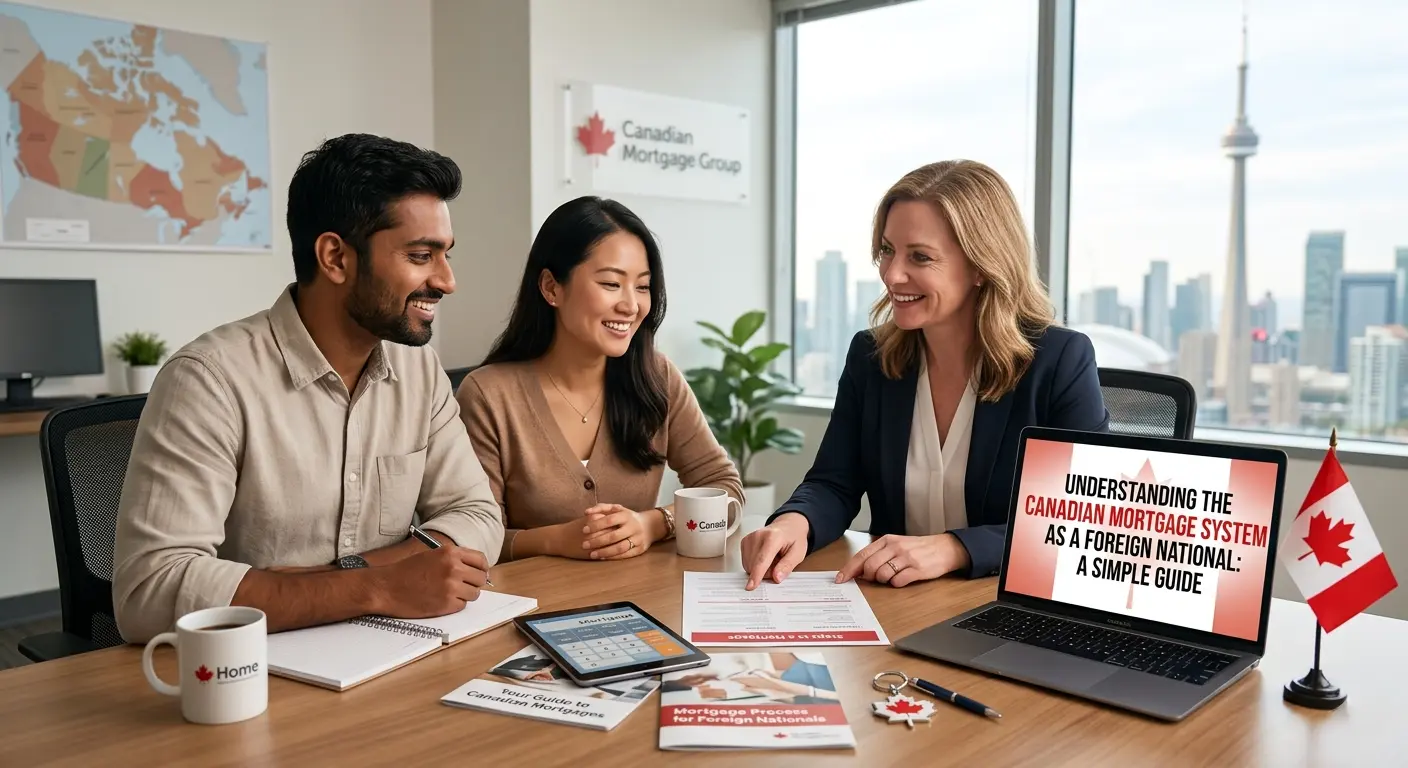
Getting a mortgage in Canada as a foreign national is completely achievable. Thousands of international buyers have been through it. But the system was built around a very specific kind of applicant, and if that isn’t you, walking in without the right preparation can make a straightforward process feel a lot more complex than it needs to be. Here’s what you need to know before you start.
Why the Canadian Mortgage System Feels Different From the Outside
Most international buyers come to the Canadian mortgage process with a strong financial profile. Significant assets, a history of responsible borrowing, a clear income picture. And they’re surprised to find that the system doesn’t automatically recognize any of it.
Canadian lending is built around Canadian data. Domestic credit history, income reported in Canada, employment verified through Canadian tax records. For anyone whose financial life exists primarily outside Canada, this non-resident mortgage guide starts with one essential truth: the standard process simply wasn’t designed with you in mind.
It’s not a reflection of your financial strength. It’s simply how the system was built, and knowing that going in makes all the difference.
Who Qualifies as a Foreign National or Non-Resident in Canada
When it comes to Canada mortgage eligibility for foreign buyers, the distinction between a permanent resident, a non-resident and a foreign national matters significantly. These designations affect which lenders will consider your application, what down payment you’ll be required to provide and what documentation the process will demand.
A permanent resident is treated similarly to a Canadian citizen for most lending purposes. A non-resident, someone who lives outside Canada but may have ties here, occupies a middle ground that different lenders handle differently. A foreign national with no Canadian residency status faces the most constraints within the traditional banking system, but also has the most to gain from working with the right advisor who knows where genuine access exists.
What Canadian Lenders Actually Look At
For anyone navigating the mortgage process in Canada as a Chinese buyer or international applicant, the assessment comes down to a few key variables.
Income verification is the first hurdle. When your earnings exist outside Canada, lenders need to establish what you make, how stable it is, and how it translates into Canadian dollars over a sustained period. This isn’t impossible to document, but it requires considerably more preparation than a standard domestic application.
Credit history is the second. Canadian lenders rely on Canadian credit bureaus, and if you haven’t held Canadian credit accounts, your file may be thin regardless of your actual creditworthiness. Some lenders will accept international credit documentation. Others won’t. Knowing which is which before you apply matters.
Down payment requirements are the third. For non-residents, these are higher than for Canadian buyers, and the source of the funds needs to be documented clearly. A larger down payment can also compensate for gaps elsewhere in the application, which is worth understanding when you’re putting the package together.
The Down Payment Question Most Buyers Ask First
The minimum down payment for a foreign national home loan in Canada is typically higher than what a domestic buyer would be required to provide.
Buyers should generally be prepared for a requirement in the range of 35% through a traditional lender, though this varies depending on residency status and property value.
Where the funds come from matters as much as how much they are. Canadian lenders require that down payment funds be documented, traceable and held in a verifiable account.
International wire transfers, gifted funds and funds held offshore all require specific handling to satisfy lender requirements. Getting this documentation in order early avoids delays that can otherwise cost a buyer a property entirely.
The Difference Between a Bank, a Mortgage Broker and a Private Lender
For most international buyers, a traditional Canadian bank is the wrong first call. The major banks operate within strict guidelines that leave little room for applicants who don’t fit the standard profile. Their systems simply aren’t built for the complexity that international buyer financing in Canada actually requires.
A mortgage broker with experience in non-resident applications operates differently. They have access to multiple lenders, understand which ones are genuinely open to foreign national applications and can position a file in a way that reflects a buyer’s actual strength rather than their superficial fit with a domestic checklist.
Private lenders offer more flexibility than institutional lenders, particularly for buyers whose profile doesn’t fit a conventional box. That flexibility comes at a cost such as higher interest rates, shorter terms and a relationship that requires a clear exit strategy. Used correctly and with proper guidance, private lending is a legitimate and often effective part of the mortgage process for international buyers.
The Step-by-Step Process From Application to Approval
The mortgage rules for international buyers Canada follow a consistent sequence.
First, documentation such as income records, credit history, proof of down payment funds and identification all need to be in order before any application goes in.
Second is pre-qualification. Understanding which lenders are realistic options and what terms are available, so a buyer knows exactly where they stand before making an offer.
Third, formal application and conditional approval. Once a property is identified and an offer accepted, the application goes in and conditions need to be met within the offer timeline.
Fourth is closing. The notary, the transfer of funds and property registration, with international wire transfer timing coordinated carefully against closing deadlines.
Most delays come down to two things. Missing documentation at the application stage, and wire transfer timing at closing. Neither has to be a problem if the groundwork has been done properly from the start.
Why Having the Right Advisor Changes the Outcome
There’s a real difference between a broker who only understands how to get a mortgage in Canada as a non-resident and one who truly understands it specifically for buyers like you.
Bernard Bachaalany makes mortgage preparation the starting point of every cross-border mandate, not an afterthought. By the time his clients are ready to make an offer, the financial side is already sorted. That’s what allows them to move quickly and confidently when the right property appears.
If you’re starting to think seriously about a purchase in Montreal or Laval, the mortgage conversation is the right place to start. Reach out directly or connect via WeChat for a private consultation.